


The days of pen-and-paper human resources management in education are long gone. Now, more efficient online systems are here that combine multiple HR and talent management functions. With an integrated system, you can tackle everything from identifying qualified candidates, interviewing, and onboarding to professional development and performance evaluations—to power more efficient schools and districts and lead to effective instruction for student success.
What does HR and Talent Management Software Do?
Playing a critical role in streamlining K-12 administrative tasks, HR and talent management software—also known as Human Resources Management Software (HRMS)—helps centralize, simplify, and automate all staffing tasks within a school or district.
A comprehensive solution consolidates multiple HR tasks in one system to offer complete hiring support, including recruitment, applicant tracking, candidate assessment, and onboarding capabilities. HR and talent management solutions are also vital to help retain staff and efficiently manage employee records, evaluations, professional learning/professional development, and substitute teachers.

Teacher Shortage Survival Guide
Tips for successfully hiring and retaining top candidates
Get the GuideWhat are the 7 Components of Talent Management in Education?
1. Applicant Tracking
An online education applicant tracking system helps manage the entire recruitment process, from posting job openings to finding the best applicants, collecting applications, and tracking candidates’ progress through different stages of the hiring process.
2. Candidate Assessment
With K-12 candidate assessment software, schools and districts can find the right candidates online with research-backed assessments, predictive analytics, and clear interview feedback.
3. Employee Onboarding
A modern, digital onboarding system can save time and better prepare new hires for their first day—with online checklists, digital storage, centralized tracking, automated alerts, and information forwarding.
4. Employee Records
HR leaders can simplify employee records management with K-12 software built specifically for education, helping with contract renewal management, e-forms and workflows, digital storage and reporting, and digital employee form submissions.
5. Staff Evaluations
Software for in-person or virtual teacher and staff evaluations can help support and retain effective educators—through flexible evaluation options, clear tracking and communication, growth plans, and support for all roles.
6. Professional Development
Tools that simplify planning, tracking, reporting, and collaboration of professional development and professional learning can enhance educators’ careers and lead to more effective student instruction and learning.
7. Substitute Teacher Management
An online absence management solution can help maximize coverage, find substitutes faster, gain insights into attendance, and ensure accurate payroll when integrated with an ERP solution.
In addition, some HR and talent management systems include, or connect to, an online job board specific to K-12 positions. An online system can help find more applicants virtually, expand your reach, recruit easier, and stretch budgets by reaching a wider audience with time-saving online posting and researching.
5 Benefits of Using HR and Talent Management Software in K-12 Education
K-12 Buyer's Guide: Professional Learning Management System
Learn how to evaluate and choose the right system for your needs.
Get the Guide1. Smoother Recruitment Process
HR and talent management software can streamline and automate the traditionally time-consuming recruitment process. With the right software, you can create job postings, receive and process applications online, screen candidates to ensure the most qualified applicants are considered, and manage all candidate information in one central, collaborative system.
2. Improved Employee Management
A centralized system helps keep better employee records and staff data, including updated contact information, qualifications, certifications, and performance evaluations that can be shared based on role permissions. You can also track employee progress and identify areas for professional learning and growth.
3. Better Evaluations to Improve Classroom Teaching
Software can improve the teacher evaluation process, allowing leaders to see what’s working and where to improve with a complete view of observations, walkthroughs, student achievement data, administrative response, self-evaluations, peer feedback, and dashboards with real-time data.
4. Effective Professional Development
As part of a comprehensive HR and talent management system, professional development can be more personalized with learning plans tied into an employee’s complete career within the school or district. Educators can access, track, and personalize their PD in person, online, or both, and learning plans can be built based on compliance needs, teacher goals, student performance data, and evaluator feedback.
5. Data-Driven Decision Making
HR and talent management software provides valuable insights through analytics and reporting. School administrators can access data on staff performance, turnover rates, training and PD effectiveness, and other HR metrics. This data-driven approach helps make informed decisions about resource allocation, recruitment strategies, and employee retention.
Key Features to Look for in HR and Talent Management Software for Education
A quality HR and talent management software solution, built specifically for K-12 education, should include features that ensure students get the most effective educators in every classroom. Software should make hiring, supporting, and retaining quality teachers easier. Key features to look for include easy-to-use tools to help you build, implement, and scale HR programs and processes, speed up hiring and onboarding, focus more on teacher support, and ease substitute management with tools that work together.
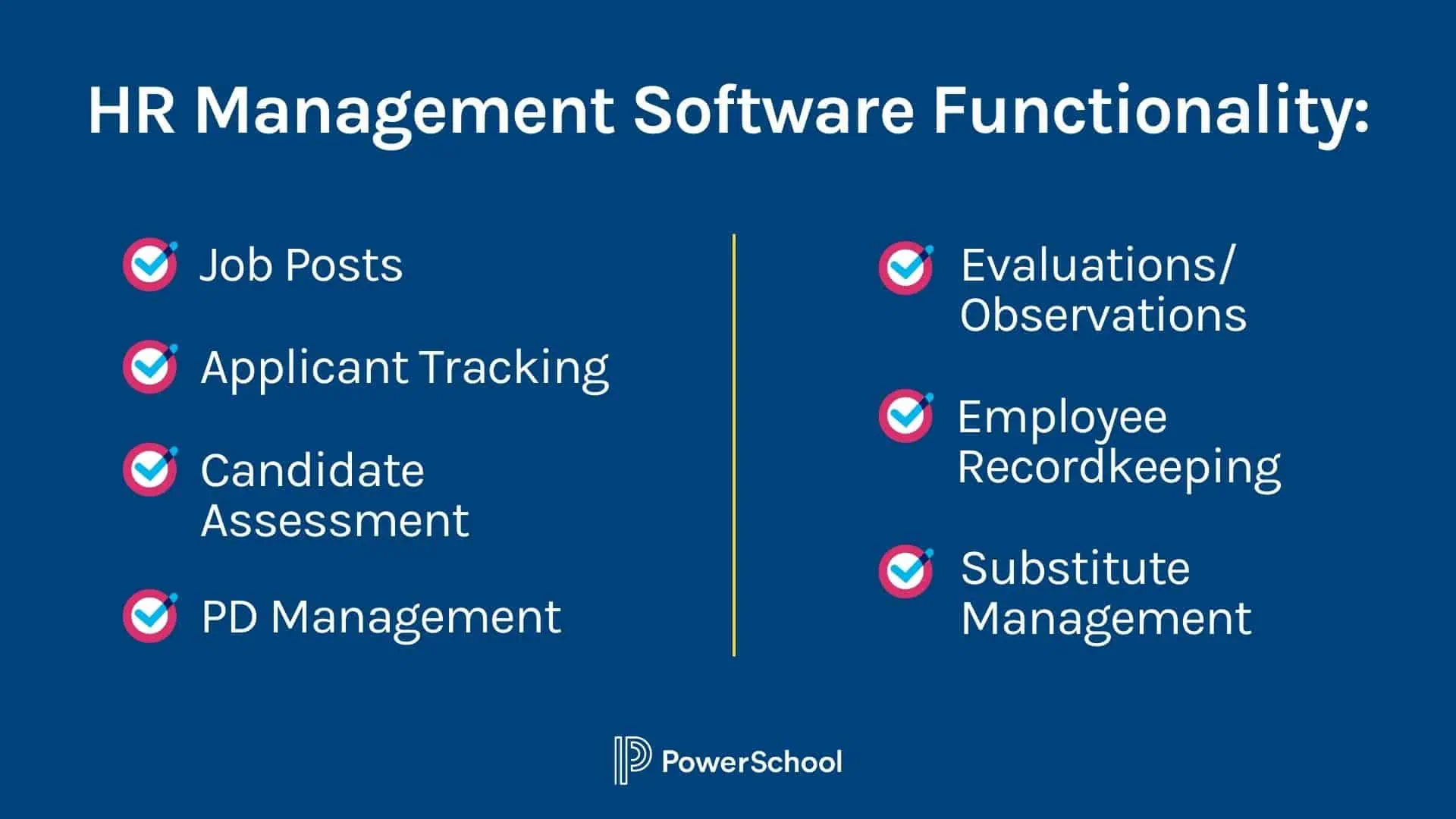
Specific modules to look for include:
- Job posting functionality, including an online job board
- Applicant tracking capabilities to help schools and districts hire the teachers and staff they need faster and easier
- Candidate assessment system, including research-backed assessments, predictive analytics, and interview feedback components
- Employee recordkeeping with self-service capabilities for employees to access their own information
- Teacher and staff evaluation and observation system, which should offer both online or in-person functionality
- Professional development management, including 24/7 accessibility and the ability for staff to choose multiple ways to learn—such as online, in-person, or collaborative learning
- Substitute management system to quickly fill teacher and staff absences

2022 K-12 Talent Index
Download the research report to learn about growing trends in K-12 talent management.
Get the ReportHow to Introduce HR and Talent Management Software in K-12 Schools
Changing software solutions can be daunting and risky. Often, schools and districts commit large amounts of time and effort to researching, reviewing, and deciding on which products to choose in the best interest of their community. Once you’ve selected a vendor, the next critical stage is implementing the new software, training users, and driving adoption before moving into maintenance mode.
Here are tips for successfully choosing and introducing HR and talent management software to ensure a smooth transition to a new system.
Identify School and District Needs
A successful HR and talent management launch depends on choosing a system for your specific needs. Start by understanding the particular HR and talent management challenges your organization faces. Identify the pain points and areas where automation and software could make a significant difference. This can involve talking to key stakeholders, such as school administrators, HR personnel, department leaders, and teachers.
Research Software Options and Compare
Every HR and talent management software solution should meet basic needs and offer unique features. Research the different options, watch product demos, compare functionality, and choose a software solution that aligns best with your needs and budget.
Secure Buy-In from Stakeholders
Once you’ve chosen a new software solution, work to get all of your key stakeholders on board by educating them on benefits and features. Show tangible examples of how the software can help them on a daily basis and also address any concerns they may have.
Implement the System
Working with an experienced, quality edtech vendor with a detailed implementation plan can help make your product introduction successful. A quality HR and talent management software vendor should provide implementation support, a dedicated project manager, and product-based training.
Provide Access to Training and Ongoing Support
Your software vendor should provide training and support options, as well as customer education, that include multiple learning methods, including live and on-demand training, both online and in-person. Ensure that all relevant staff receive comprehensive training on effectively using HR and talent management software.

Watch a Demo Now
See if a Human Resource Management System (HRMS) might be right for your needs.
Watch NowBest Practices for Maximizing the Use of HR and Talent Management Software in K-12 Education
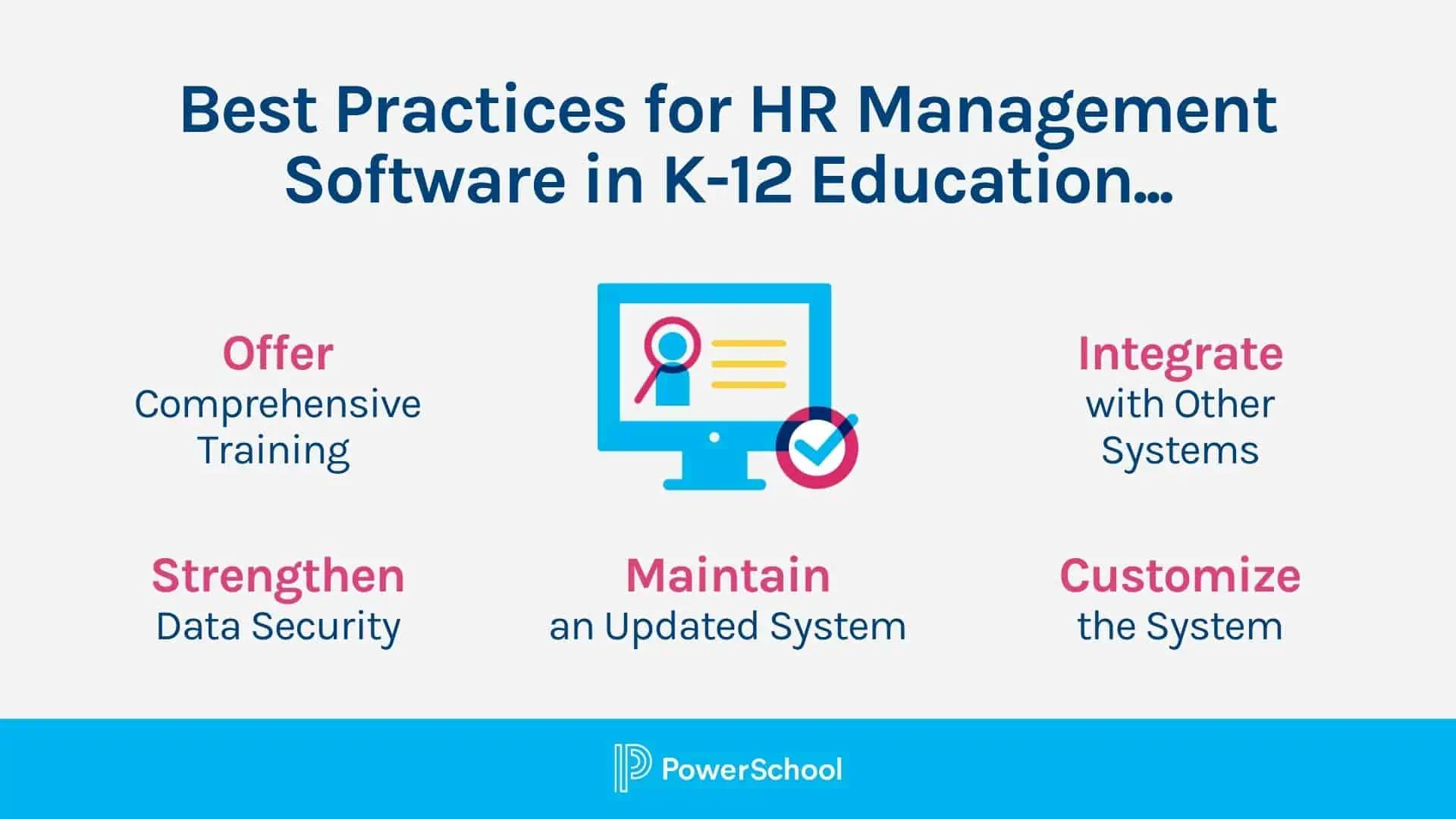
To ensure your HR staff effectively uses your system after implementation, adopting best practices is essential.
Offer Comprehensive Training
From the beginning, all users need thorough training and support to understand the basic functionality and features essential to their role. It’s also important to provide follow-up support that staff can access daily.
Customize the System
Choosing a flexible system that can be tailored to your specific school or district needs is critical. Your users should be able to customize data fields, workflows, and reports, which are beneficial to improving efficiency and user adoption.
Strengthen Data Security
Your HR and talent management software vendor should take all reasonable and appropriate countermeasures to ensure your data confidentiality, integrity, and availability. Within your organization, implement robust security protocols to safeguard sensitive employee data stored in the software. Define user access levels and permissions based on roles and responsibilities to protect data privacy.
Integrate with Other Edtech Systems
By choosing HR and talent management software that integrates, you can connect systems, such as your student information system (SIS) or payroll and finance software. Seamless integration enhances data flow and efficiency, improves security, and reduces redundant data entry.
Maintain an Updated System with Software Enhancements
Keep track of software updates and new features the product vendor releases and connect with the product user site. Take advantage of enhancements that improve the software’s capabilities and user experience.
7 Ways HR Education Software Streamlines Recruitment and Hiring
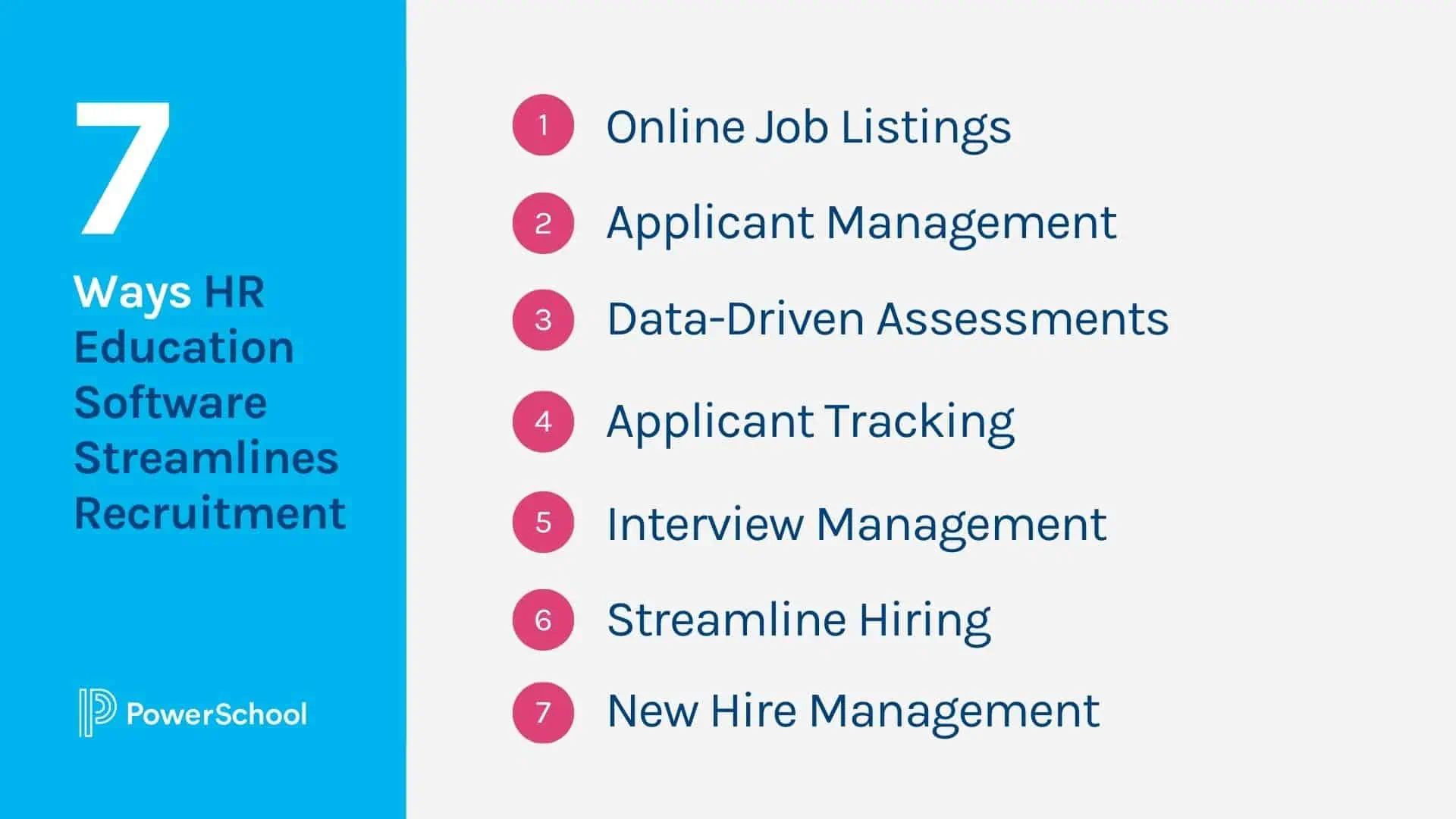
1. Online Job Listings
A comprehensive HR and talent management solution can provide a centralized in-house job listing resource site, serving as a self-service, one-stop-shop for applicants. Applicants can apply, upload documents, and review and update their information without assistance from HR, saving your staff time and resources. Filters and sorting options can help candidates quickly find jobs.
2. Applicant Management
Candidates can submit their applications directly through the software’s online portal. You can accelerate the application process with tools to review applications and route them to the appropriate hiring manager. Automation helps move from application to interview faster.
3. Screen Candidates with Data-Driven Assessments
An online assessment can be sent to applicants automatically when they apply. Assessments can evaluate attitudinal factors such as cognitive ability and teaching skills. Advanced systems can also assess different types of positions, including teachers, principals, or administrators.
4. Applicant Tracking
HR software can track candidate progress, making monitoring their status and communications simple.
5. Interview Management
Online HR education software can allow you to schedule interviews with multiple candidates at once, see interview statuses at a glance, share results with other decision-makers, and provide hiring recommendations.
6. Streamline Hiring
With HR and talent management software, you can view, sort, and select best-fit candidates, all online. Advanced systems allow you to initiate hiring with templated offer letters and an online portal for candidates to accept or decline the job.
7. Onboarding and New Hire Management
Once a candidate is selected, HR software can streamline the onboarding process by automating the creation and distribution of new hire paperwork, training materials, and orientation schedules.
How HR and Talent Management Systems Integrate with Other Core Edtech Solutions
One of the most important ways an HR and talent management system integrates with other school software is through payroll and finance solutions. With an integrated solution, districts can ensure a more effortless onboarding experience and accurate, on-time payroll.
For example, PowerSchool’s talent products—a comprehensive HR and talent management solution—integrates with PowerSchool™ eFinancePlus, K-12 finance and HR software, to streamline the budgeting, hiring, and payroll processes. From budget allocation for a new job opening to hiring and paying, combining these products provides real-time, two-way integration so teams can take advantage of both powerful solutions. Finance leaders can define and share approved staffing budgets, and HR departments can use detailed line item information to successfully recruit, hire, and onboard new staff.
In another example, the PowerSchool Educator Effectiveness Cloud brings together multiple education technology products to help retain talented educators and improve teacher support through practical evaluation and coaching practices. The cloud platform includes integrated PowerSchool tools to help:
- Improve educator effectiveness by identifying teacher strengths and opportunities for growth to provide meaningful, actionable feedback and direction.
- Increase teacher retention by championing continuous learning through systems that promote transparent evaluation, feedback, and growth.
- Support and inspire professional development engagement by giving educators the freedom and flexibility to learn on their schedule for more meaningful engagement.
- Turn evaluations into growth plans by providing personalized professional learning informed by student performance data to support teacher retention and directly target student achievement.
Integrated products can also impact recruitment and onboarding. The PowerSchool HR & ERP Cloud provides K-12 schools and districts with integrated tools and functionality to simplify and streamline recruitment and onboarding to attract top talent. With the platform, you can:
- Boost candidate reach and engagement
- Reduce administrative tasks
- Achieve data-driven recruitment optimization for an efficient hiring experience

