Executive Summary: 2023 Education Focus Report
Introduction
K-12 education is in a time of tension, caught between the urgent, the important, and the possible.
Student learning and wellness recovery is both urgent and important. We recognize that school and district leaders are under public pressure and scrutiny to maximize the influx of federal and state resources to get students back on their pre-pandemic paths. There is always a balance to be struck— in education as in any other sector— between urgency and importance. But we also know that existing practices leave opportunities to enhance the educational experience, so there is the project of innovating toward the possible.

Speaking with dozens of education leaders and receiving over 1,700 responses through our annual national survey, we heard a collective sense that personalized learning, actionable data, and artificial intelligence (AI) hold promise to shape the future trajectory of education.
Recognizing these current dynamics in education, our 2023 Education Focus Report focuses on four key areas:

Throughout this year’s report, we elevate educators’ voices, believing the future of education should be informed by their input today.
We are listening to educators as they balance the urgent and important while innovating to achieve the possible.
 the Student Learning Experience
 the Student Learning Experience
For many education stakeholders—families, students, policymakers, and educators— the rapid adoption of technology during COVID fueled expectations of fast and transformative change. Schools and districts are now moving through the opportunities and challenges inherent to the quick adaptation and learning of new technologies.
In the full report, we consider both school and district leaders’ top edtech challenges and priorities in the context of pandemic learning recovery.
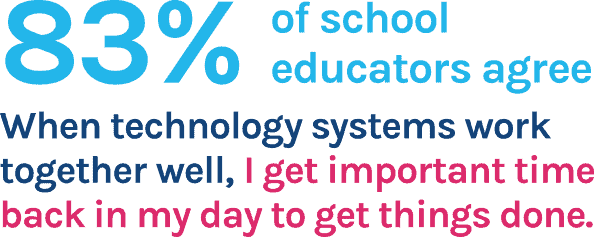

School challenges reflect the practical issues that come with relying more heavily on technology in the classroom. District challenges include achieving overarching data initiatives while providing sufficient professional development for educators to learn new technologies.

We also look deeply into educators’ edtech priorities to understand needs and uncover strategies that work.
At the school level, incorporating technology into teaching remains top of list, along with data, assessments, and reporting. Schools are in the midst of a tech revolution that is the story of the current time.
Change does not come easily. Unanticipated problems and priorities arise, such as motivating students to learn both classroom skills and content (abilities beyond rote fact memorization) when their phones can find the answer to anything.
For district leaders, connecting and integrating the pixelated data of each child into a crisp and full picture that tells a story is the central priority. Moreover, understanding which pandemic response efforts are truly effective and which are not is finally becoming possible for many district technology and research offices.
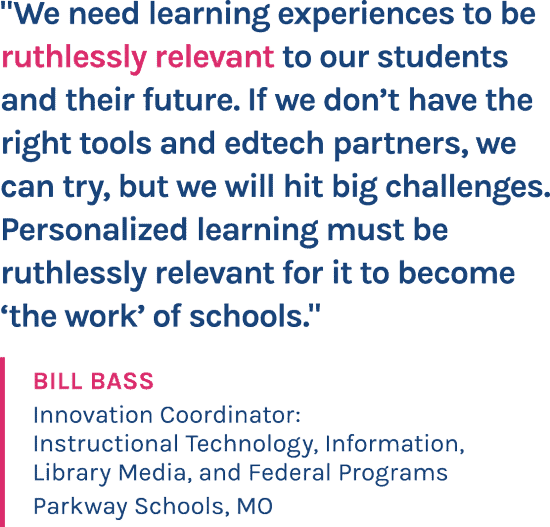

In addition, we revisited the state of personalized learning. Some district leaders point out a fundamental hurdle: personalized learning suffers from an optics problem. It is often seen as “extra” work rather than the “core” work of teaching and learning.
In the full report, we dig into how system leaders are fusing personalization and existing practice to become “the work.”
We also asked educators for their perspectives on the potential of AI to enhance teaching and learning. We found that school-level educators exhibit cautious intrigue, while district leaders are more optimistic and hopeful.
 Educators and Instruction
 Educators and Instruction
Educators see and appreciate the value that tech tools and innovation bring to their classrooms. Educators identify innovations like AI-based content prompts and instructional suggestions as having most potential to positively impact student learning. If the content is standards-aligned, all the better.
However, the practice of rapidly adopting tech tools without fully training those who need to use them leaves educators feeling overwhelmed.
Having technology and using technology with purpose and intention are two different things. Educators indicate that the race to adopt technology has in some cases strayed from its central purpose: to create a better learning experience for the student. Purposeful professional learning merging new technologies and strategies to support every learner remains a top need.
We also heard from educators that computer-guided learning content and career exploration innovations hold great potential to help students.
Speaking with education leaders in K-12 and postsecondary, we heard a growing need to incorporate career readiness skills into K-12 instructional best practices.

We explore emerging strategies to support this work through technology in the full report.

 for the Future with Usable Data
 for the Future with Usable Data
In the full report, we dig into how system leaders are fusing personalization and existing practice to become “the work.”
According to our national survey, 7 in 10 school-based educators agree with the statement, “I have usable data at my fingertips to help improve the quality of instruction.” In the full report, we consider what is meant by usable data and explore how data managers are architecting tools and platforms to support teachers.
We also discuss how multi-tiered systems of supports (MTSS)—and similar practices— are evolving as result of the pandemic.
“Sometimes you need a facilitator for change. COVID was it,” reflects Tessie Bailey, Director of MTSS at the American Institutes for Research (AIR) about MTSS and how educators are taking a more pragmatic approach to streamline supports rather than maintaining perfect fidelity to a given model.
“We need to step back and prioritize the things that produce the biggest effects. To do that, we need to edit, and in some cases,
subtract in order to simplify the [MTSS] work. Less can be WAY more. Giving kids the opportunity to learn using well-designed instruction and supporting their growth— that’s what matters most,” shared Bailey.In addition to MTSS, this section highlights an emerging innovation in data in education with data as a service (DaaS) solutions.
We speak with Tim Clark, VP of K-12 Programs at 1EdTech, about a range of topics, from interoperability to innovation and the latest insights on effective data governance. He discusses the promises and perils of increasingly popular cloudbased approaches to data governance through DaaS tools like data lakes, warehouses, and exchanges.

In the full report, we consider how data governance practices are enabling new technologies like DaaS and how leaders are navigating collaboration and security.
with Parents and Caretakers in Student Learning
 with Parents and Caretakers in Student Learning
Lastly, we look at how parents and caretakers can become even stronger learning partners. We consider strategies and systems that promote student attendance and home engagement. We explore parent preferences versus reality in how schools communicate and share updates about student learning.
Most educators say tech is streamlined to communicate with parents, while 7 in 10 parents say they must navigate 2-6 systems to access the information they need to understand how their student is learning. The proliferation of technology has moved districts to consolidate tools or source partners who offer multiple solutions in one tool.
Many districts have too many tools with too specific use cases. For example, they need tools that handle learning updates, communication at home, and track attendance all in one. It is not unordinary for districts to use multiple technology platforms across grade spans (elementary, middle, high) and communicate with families through all three, depending on the ages of the families’ children.
The use of multiple platforms often results in a deluge of information for parents, which causes them to feel frustrated and overwhelmed, or even shut off the school “information spigot” entirely.

How PowerSchool Can Help
The future of education starts with listening to educators today.
Our conversations with educators, administrators, and families have surfaced four key actions that PowerSchool is committed to addressing.
If we build and support systems that personalize education to deliver a richer student learning experience, we believe we can help educators and students get what they need from technology:

At PowerSchool, we remain committed to empowering educators to help each student find success in the way that’s right for them.
As a leading cloud-based software provider in North America, we know this means innovating to deliver education technology that offers an intuitive, user-friendly experience for all education stakeholders. Soon, for example, PowerSchool will launch single sign-on (SSO) capabilities that deliver convenience and insight to families to strengthen school-parent partnerships.
Additionally, in 2023 we launched our PowerSchool Clouds, marking the first time an edtech company packaged best-in-class technologies intentionally designed to meet the evolving needs of schools and district leaders.
And knowing that data is only useful when it is secure, connected, and accessible, we are using AI to support educators and state agencies toward data-driven planning to meet the workforce needs of today and tomorrow with Connected Intelligence.