Practical tips to help you compare and choose quality student information system software for your unique needs.
With tight budgets and a long list of education priorities, schools and districts need to ensure their edtech investments are a best fit for their needs. Smart technology purchases have to meet top strategic initiatives and improve operational efficiencies.
Your student information system, which serves as the heart of your digital ecosystem, is the most crucial software investment you can make to impact your operations. As your core data management system, the SIS is a significant investment that fuels student success in the long run. These powerful applications set the solid foundation for your ability to scale the management of your essential school processes. Your SIS forms the basis for successful learning environments. And, ultimately, it offers educators and administrators insights and opportunities to drive student achievement.
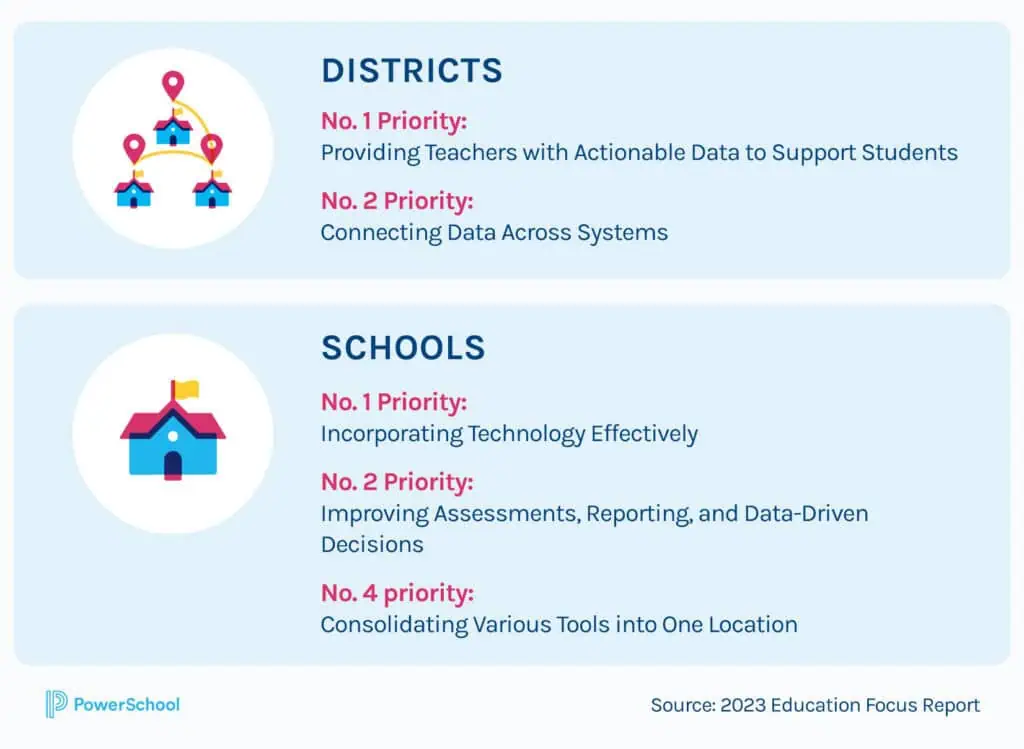
If you’re upgrading to a new student information system, there are several critical factors to consider. Compare each system’s core functionality and features—like the ability to provide accessible and actionable data. According to the 2023 Education Focus Report, district leaders’ No. 1 priority is providing teachers with actionable data to support students. Educators also value data, saying their No. 2 priority is improving assessments, reporting, and data-driven decisions.
Other key features to look for include product interoperability, data security, ease of use, and family engagement tools. Assess an SIS’s ability to handle compliance reporting for accurate state submissions, and find out what types of training and support options are available to get you up and running quickly and successfully.
 We look at all of these factors and more in the 2024 K-12 Student Information System Buying Guide. To help get you started, here are five key questions to ask when choosing a student information system.
1. Is the SIS interoperable with other edtech products?
In the Education Focus Report, district leaders told us that connecting data across systems was their second highest priority, and school leaders said their top priority was consolidating various tools into one location.
That’s why interoperability between your edtech products is crucial.
Your SIS should be compatible with your other digital tools, including the ones you have now and those you may need in the future. Ideally, SIS companies that offer other education technology solutions within their product suite and bi-directional SIS data exchange with third-party software partners expand your capabilities and better prepare you for the future.
“The integrations offered by PowerSchool SIS helped us incorporate online software and textbooks, which eased some of the challenges we faced during the pandemic. It truly was the hub of the wheel in our district,” says Ben Davidson, Application Support Specialist at Michigan’s Berrien Regional Education Service Agency.
 2. Is the SIS secure to ensure student data security and privacy?

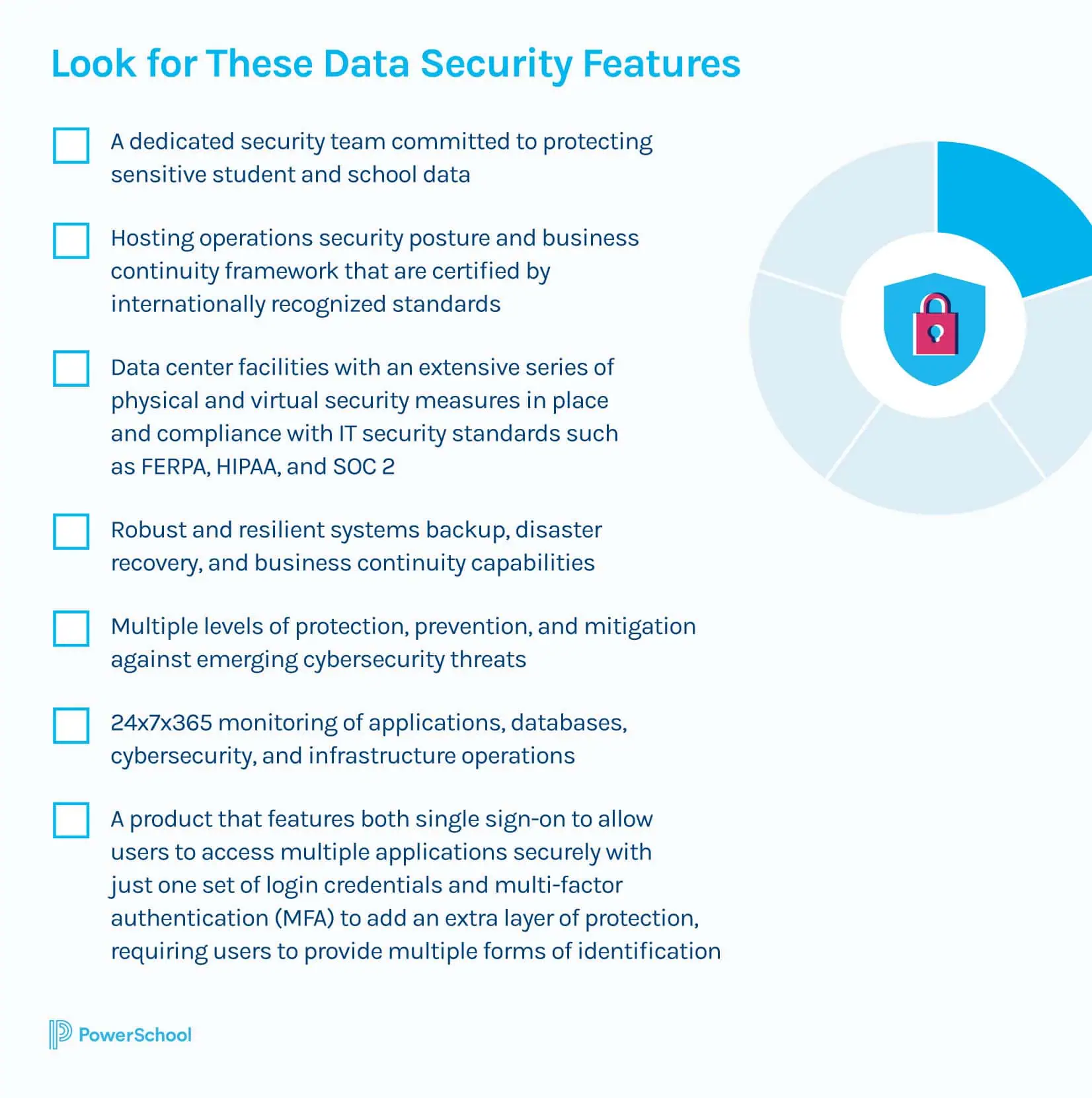
Now, more than ever, information security vulnerabilities threaten school districts’ protection of student, class, and school data. Security and privacy issues are becoming more prevalent in K-12 education. That’s why it’s essential to partner with an SIS vendor committed to the security of student, class, and school data—taking all reasonable and appropriate measures to ensure data confidentiality, integrity, and availability.
Download this infographic to assess an edtech vendor’s qualifications for keeping your student, staff, and school data secure.
Another key to protecting sensitive school data is choosing an SIS vendor with secure, cloud-based hosting. A quality hosting provider helps reduce risk by providing fully redundant infrastructure services, multiple levels of data recovery, and cutting-edge security technologies.
“I feel PowerSchool is doing an excellent job maintaining secure student data. Our servers are stored offline with redundancy, so we will never lose data or have to worry about old hardware upkeep and replacement,” says Elizabeth Migalla, Information Technology Coordinator at Illinois’ Winnetka School District 36.
 3. Is the SIS able to handle our compliance reporting, especially in our state?
Each state and province has different compliance reporting requirements, which change constantly. Your SIS must stay current to ensure K-12 districts receive maximum funding.
Inefficiencies and inaccuracies in reporting can prove costly, as school funding largely hinges on timely and accurate reports. With continually changing state reporting requirements posing ongoing challenges, SIS vendors must create, update, and monitor reporting for each state. The most fully functional systems are built to respond to these changes and—with the support of an experienced compliance team—deliver the required information efficiently and accurately.
“I love working with PowerSchool. Since Alabama is utilizing PowerSchool SIS statewide, we have reduced the number of reports and paperwork that is required, because the Alabama Department of Education can sync and download the data they need on their end. All in all, PowerSchool SIS provides a wealth of data and information for its users!” says Shannon Uptain, Curriculum & Instruction Specialist at Alabama’s Sheffield City School District.

4. Will data be presented in a way that supports decision-making?
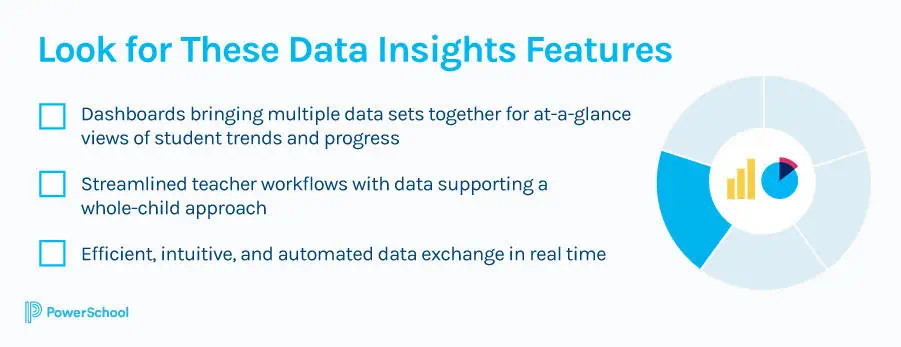
Educators need real-time, actionable data in one convenient location. That way, they can easily view the whole child and personalize learning based on each student’s unique needs.
Data that’s easily accessible—presented in a usable, clean, and organized way—gives you insight into trends in student learning and performance. It takes the guesswork out of identifying classroom challenges and empowers teachers and administrators to make more informed decisions.
“Our district is always looking to implement innovative technology that can lead to better workflows for our staff. Our PowerSchool solutions have helped us drastically reduce time spent on administrative tasks and have provided key insights for us to create more data-informed decisions,” says Dana Fall, Superintendent at Cherokee County School District 1, SC.
5. How does the system help improve family engagement?
According to the 2023 Education Focus Report, most educators say technology is streamlined for communicating with parents. However, 7 in 10 parents say they have to navigate 2-6 systems to access information on their students.
A student information system can simplify family engagement by communicating a complete, real-time view of student performance to families. Also, regular communication between teachers and families through the SIS keeps everyone on the same page, driving student accountability and success.
Here’s what Christopher Stengel, Director of Technology at Pennsylvania’s Mt. Lebanon School District, says about their ability to engage with parents via their student information system: “Throughout our journey, having this platform (PowerSchool SIS) enables a focus on individualized learning and family involvement in learning. We used to have a custom-built parent/family web interface that took nightly exports from our former SIS and presented simple information like grades and homework assignments to the homes of our students. As soon as we started using PowerSchool SIS, we did away with that website and were able to focus on the content that was being delivered through the portal rather than the specifics of the portal itself.”


Get the 2024 K-12 Student Information System Buying Guide
In this 3-part eBook, gain solid insights to effectively evaluate your current SIS and learn how to choose a system that meets your school or district’s needs.
Get Your Copy