

Help teachers work more efficiently and effectively with improved, streamlined workflows and data access from using interoperable K-12 edtech products
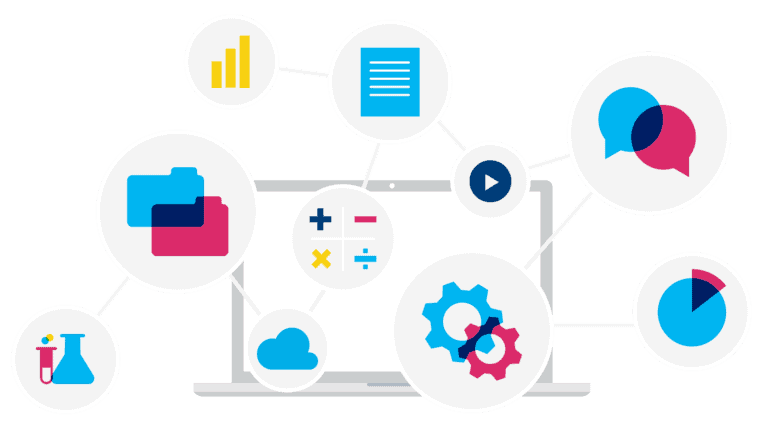 Digital tools should improve a teacher’s ability to give students the best opportunities in life. But when software products are fragmented and don’t communicate with each other, a teacher’s time can be wasted with labor-intensive and frustrating tasks of manually entering the same data within multiple programs, or trying to pull together cohesive data from various systems.
That valuable time could be better spent on actions that actually impact student success: things like working closer with individual students, identifying the best resources for the curriculum, and crafting engaging lessons for their students.
According to a Digital Promise study, 74 percent of districts use more than 26 different education technology products and another 17 percent of districts use over 100. When teachers have to maneuver between so many products, it makes sense that studies show only 42% of a teacher’s workday—which averages 10 hours, 40 minutes—is spent teaching in the classroom.
A streamlined experience between software products can help. Edtech interoperability (when different products communicate and share data cohesively) can streamline a teacher’s day, as well as give them better, more insightful data pulling from multiple sources.
What is Edtech Interoperability, and What Does It Mean for K-12 Edtech Tools?
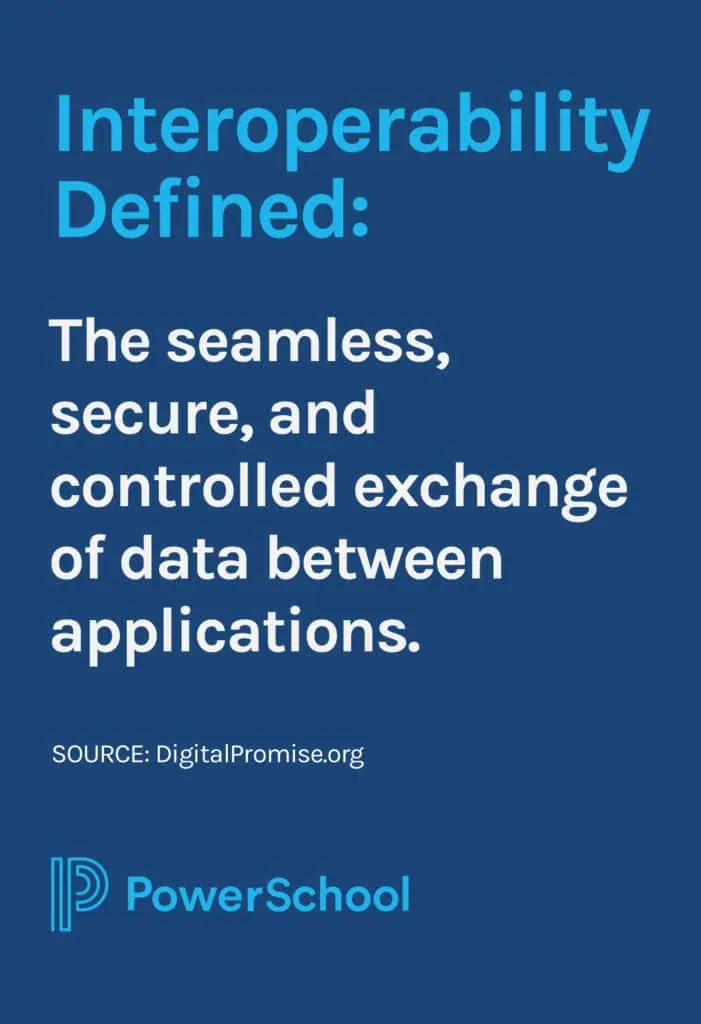 In EdTech Magazine’s Empowering Teaching and Learning with Interoperability, authors Douglas Konopelko and Tim Clark, Vice President, K-12 Programs at IMS Global Learning Consortium, explain interoperability as “…multiple systems sharing a language or a framework for language that’s designed to help them function together as a whole to improve usability and/or security. Interoperability in practice might look like many systems acting as one based on a shared data standard. Interoperability is synchrony.”
It’s common for a teacher to use one software system for grading and building a class page, and another to deliver assessments. And yet another to manage IEPs or gifted and talented student performance. Each of these systems collects and shares data in its own way, and it can be challenging to make sense of it altogether. To see how a specific student is doing in one of their classes, or how a group of students has performed over the past three weeks, they may have to open multiple software solutions to compare data. They’ll likely have to manually re-enter the results for each student from each program into the grading system.
The more tools teachers use, the more difficult it becomes to manage data when they are not interoperable.
Here’s the thing:
An interoperable solution that integrates with other edtech products can make your user experience more streamlined, convenient, and natural to maneuver between programs—much like you’re using one overall program. Users get familiar with how applications function, how to navigate quickly, and how to increase productivity. In addition to fostering a healthy tech ecosystem and learning environment and giving teachers a complete view of student progress with shared data, interoperability can make the school day smoother and more productive so teachers can focus more freely on students.
UT
The less a teacher has to worry about managing tools, the more time they have to work with students!
Stacey King Teacher
Utah Online High School
“The purpose of a teacher is to help students learn,” says Stacey King, a teacher at Utah Online High School. “There are some housekeeping items that will always need to be done and that are helpful in gauging student understanding and personalizing learning. However, when there are too many systems, programs, and tools to manage, the teacher’s job turns more into a system management role, which takes time away from helping students learn. The less a teacher has to worry about managing tools, the more time they have to work with students!”
In short, interoperability can do wonders for streamlining your workflow and making it easier, and more productive, to use multiple edtech products to their fullest. Here are 3 ways you can improve a teacher’s day through a more efficient, smoother—and interoperable—experience.
1. Interoperability Makes It Easier to Access and Use Data in the Classroom
When products connect and share student data, teachers in and out of the classroom save time when they don’t have to pull information from multiple sources manually. In addition to easier access to that data, you also get a more holistic view of the student, which results in more efficient informed decision-making. Teachers can quickly see all information for the student or an entire class, like grades, assessments, attendance, and more in one convenient dashboard. The result is that they’re better prepared to make sound decisions for instruction, including personalized learning choices.
But if a teacher has to look at multiple data sources on disconnected platforms in different views, or has to manually pull the data together into a spreadsheet, it’s much harder to draw meaning from the data.
King agrees, saying, “When tools work together to allow students to access them all with one sign-on, it is a game-changer! It improves student engagement, productivity, and learning as well as providing valuable data to the teacher that can be used in personalizing instruction and focusing on the individual needs of students.”

She relies on the integration between PowerSchool SIS and PowerSchool Schoology Learning to reduce administrative tasks. She says, “It is amazing to be able to do everything in Schoology and have it all sync back to PowerSchool. It saves hours of time inputting grades manually!”
Sean Coffron, an Instructional Technology Training Specialist at Manassas City Public Schools, uses an interoperable student information system and learning management system from PowerSchool, and says, “The fact that PowerSchool has data integrated with the SIS and Schoology saves me time in data and assessment work.”
In return, when teachers don’t have to spend time manually transferring data, they can spend that valuable time learning how to better analyze comparative data to meet students’ needs.
2. Interoperability Makes It Easier to Adopt, Learn, and Use New Technology
Adapting to change with new technology can be frustrating for teachers, and it’s not uncommon for products to go unused (but still paid for) after a short trial period. But when products connect through interoperability, or share the same user experience or interface, it can be much easier for teachers and students to adopt, and then learn and use the products. Especially if the new software already has the same interface teachers or staff are already using.
“The ease of learning something new depends on the ability to integrate the information with prior knowledge,” says Coffron. “Having a new application that uses the same interface assists in ease of use and taking usage to the next step. Time is saved by not having to learn a whole new system. In addition, a more efficient platform helps to avoid switching mindsets or frames of reference.”
Stefan San Miguel, Teacher/Digital Learning Specialist at Kerr High School, Alief ISD, adds, “I usually don’t consider using new products unless they are already interoperable with the products I already use. As an educator, we are already overwhelmed with so many products and services being offered to us. Products that build on what I am already using within the Schoology and PowerSchool platform are products that I’ll explore immediately.”
3. Interoperability Saves Teachers and Students Time with a Simpler Workflow
The most significant benefit of an interoperable system in terms of a streamlined experience is saved time, starting with single sign-on. Once a teacher is logged into edtech products that are connected, when they add assignments or grade tests, everything is automatically transferred into the correct data system of record.
Simply put, with one login, you can “Set it and forget it,” says Jerome Ohnui, Data Specialist at Troy School District. “Teachers and students can log onto necessary resources right away instead of waiting for manual uploads and memorizing yet another credential combination.”
“Interoperable products help me stay organized and increase my efficiency,” says San Miguel. “I can easily transition from one task to another in one convenient location where I track student progress, gather assessment data, and build new materials to increase student engagement. Being able to use a single sign-on to access all my educational products from one page is extremely convenient. I don’t have to worry about remembering different passwords, or saving bookmarks to different applications that I use daily.”
In addition to saving teachers time, it can also save tech directors and staff time and frustration when their schools and districts are using interoperable edtech products. “I can focus on bigger problems and fixing broken things rather than having my time eaten up by the minutiae of things that can and should be automated in the 21st Century,” says Ohnui.
Carmen Lagalante, Educational Technology Specialist at JSerra Catholic High School, adds, “When I don’t have to create accounts, import CSV files, or manage one more dashboard, I can focus on helping teachers use the technology in meaningful ways.”
How to Know if Your Edtech Products Are Interoperable
While many edtech vendors may claim to integrate with a wide range of products, one way to know for sure is to check with the leading organizations working towards interoperability. These include Ed-Fi Alliance and IMS Global.
Ed-Fi Alliance has developed the Ed-Fi Data Standard, which is “the set of rules for the collection, management, and organization of educational data that allows multiple systems to share their information in a seamless, actionable way.” PowerSchool supports Ed-Fi interoperability with several implementations of the Ed-Fi standards in our SIS solutions. These help us efficiently deliver state regulatory information where states have adopted this solution. We also have a presence on working groups and are committed to increasing work with them in the future.
IMS Global is the leading non-profit collaborative advancing edtech interoperability, innovation, and learning impact. IMS enables a plug-and play-architecture and ecosystem that provides a foundation on which innovative products can be rapidly deployed and work together seamlessly. PowerSchool has IMS Global support in several products, including PowerSchool Schoology Learning (OneRoster, LTI, Common Cartridge), Performance Matters Assessment and Analytics (LTI, QTI), and PowerSchool SIS and eSchoolPLUS (OneRoster).
PowerSchool’s commitment to the highest standards of interoperability practices is important to Barbara Nesbitt, Assistant Superintendent for Technology Services, School District of Pickens County. “We had a vision of one digital interoperable ecosystem, and one of the components of our rubric in procuring software is its compliance with the IMS standards, particularly with OneRoster, Common Cartridge, and LTI. We want to make sure that we’re managing rostering for our teachers. If we can save 10 minutes of a teacher’s time in administrative tasks every day, we’ve given them back a week of planning every year.”
In addition to PowerSchool’s commitment to IMS as represented by the implementation of the standards in our products, we have participants on both working groups and steering committees, including a co-chair of the OneRoster steering committee, and a co-chair of the Digital Curriculum Product Steering Committee. PowerSchool is also a K-12 Institutional Sponsor for the CASE network, which is helping to drive alignment around standards and materials across products.
“We wouldn’t buy anything without interoperability.”
As schools and districts rely more on digital tools, especially with online and blended learning becoming a necessity, the importance of a smooth, streamlined experience is heightened. The difference between a productive, positive, interoperable experience using communicative products with a shared dashboard, compared to a fragmented, frustrating, time-consuming—and ultimately unproductive—experience can be immense.
The path to interoperability and a more productive, smoother experience can become easier once others start seeing the benefits. Nesbitt explains, “Once you get more and more resources that are interoperable and flow easily—when teachers see the beauty of being able to build a wonderful Schoology unit that has 10 different resources, including a textbook, free resources, a video, a web application, and an assessment, and the kids are just clicking and going from one thing to the next, and you’re able to see actionable data on all that—the teachers will demand it.”
“We wouldn’t buy anything without interoperability because our teachers have grown to expect it.”

Do you have the right interoperable tech tools in place?
Find out in this quick assessment.
Take the Assessment